
Governing Safe and Responsible AI within Digital Public Infrastructure
As governments increasingly integrate artificial intelligence into core public systems, an important question arises: how can these technologies strengthen trust, rights, and inclusion rather than undermine them?
This question was at the centre of the FOC’s Task Force on AI and Human Rights (TFAIR) session titled “Governing Safe and Responsible AI within Digital Public Infrastructure (DPI)”, held on 18 February 2026 at the AI Impact Summit in New Delhi. The session brought together government representatives, civil society, and private sector experts to examine how AI can be embedded into digital public infrastructure in ways that promote efficiency, innovation, and the protection of human rights.
Opening interventions were delivered by H.E. Alar Karis, President of the Republic of Estonia; H.E. Bernard Maissen, State Secretary and Head of the Federal Office for Communications of Switzerland; H.E. Taurimas Valys, Vice Minister of Lithuania; and H.E. Harry Verweij, Ambassador-at-Large for Artificial Intelligence of the Kingdom of the Netherlands.
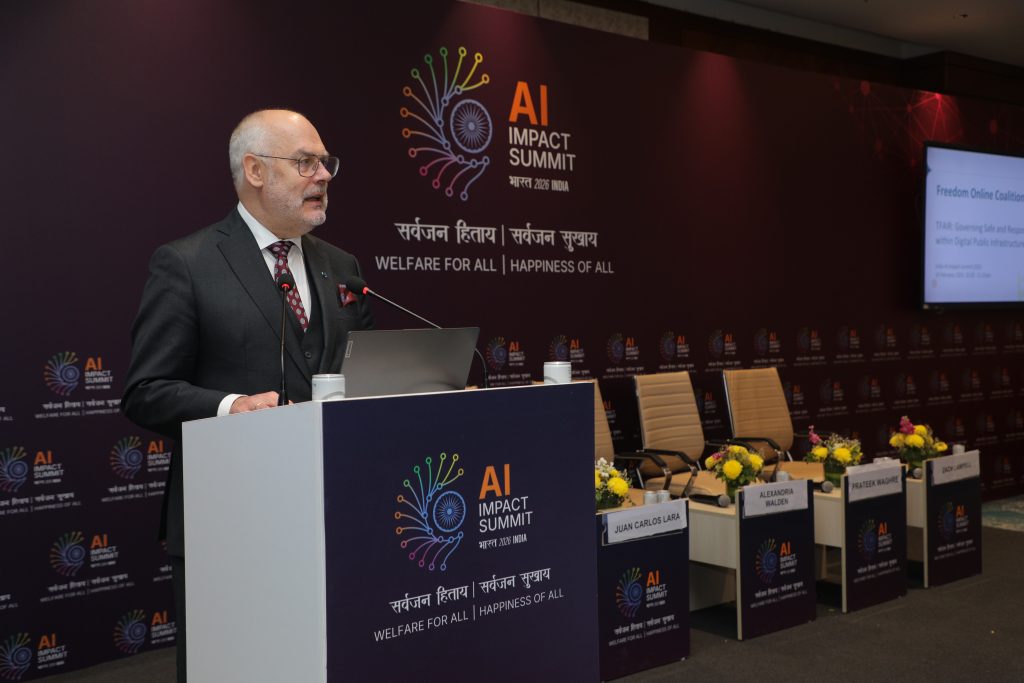
Safe and Responsible AI in Digital Public Infrastructure
Participants highlighted the significant potential of AI-enabled DPI to improve the delivery of public services, enabling governments to provide services that are faster, more efficient, and more accessible at scale. However, speakers emphasised that the deployment of AI within public systems must be accompanied by strong safeguards to ensure transparency, accountability, and the protection of human rights.
A key theme throughout the discussion was the importance of designing AI systems responsibly from the outset. Participants stressed that governments and developers should learn from previous experiences with digital technologies and prioritise rights-respecting approaches in the design and implementation of AI-enabled systems.
Multistakeholder Collaboration and Global Perspectives
The discussion also underscored the importance of multistakeholder collaboration in developing governance frameworks and best practices for AI within DPI. Governments, civil society, academia, and the private sector all have an important role to play in shaping approaches that are both innovative and aligned with international human rights standards. To this end, the discussion underscored the need for investment in multistakeholder processes and systems to continue to be a priority for governments around the world.
Participants emphasised the importance of incorporating perspectives and experiences from the Global Majority in the design and implementation of DPI systems. Ensuring that these voices are reflected in policy discussions and governance frameworks should not only be viewed as a way to enhance inclusivity, but also as a critical factor in developing more effective, context-responsive technological solutions.
Strengthening Accountability and Trust
As governments increasingly rely on automated systems to inform or make decisions, participants emphasised the need for governments to establish mechanisms to review automated decisions and address potential harms when they occur. Transparent governance frameworks and effective oversight were identified as key elements for maintaining public trust in AI-enabled systems.
Speakers also highlighted that rights-based approaches to technology development do not hinder innovation. Rather, embedding human rights considerations into the design of AI systems can lead to more durable, trustworthy, and effective solutions.
Advancing Rights-Respecting Digital Public Infrastructure
During the session, the FOC highlighted its Rights-Respecting Digital Public Infrastructure Principles, which aim to guide governments and stakeholders in developing digital infrastructure systems that align with international human rights standards.
Looking ahead, participants emphasised the importance of translating these principles into practical policy measures and governance mechanisms, including through procurement standards and regulatory frameworks that support responsible AI deployment in public systems.
The panel discussion was moderated by Zach Lampell, Senior Legal Advisor at the International Center for Not-for-Profit Law (ICNL) and Co-Chair of the FOC Task Force on AI and Human Rights. Panel speakers included Prateek Waghre, Head of Programs and Partnerships at Tech Global Institute; Juan Carlos Lara, Executive Director of Derechos Digitales; Norman Schulz, Deputy Head of Unit for AI and Digital Technologies in Foreign Policy at Germany’s Federal Foreign Office; and Alexandria Walden, Global Head of Human Rights at Google.