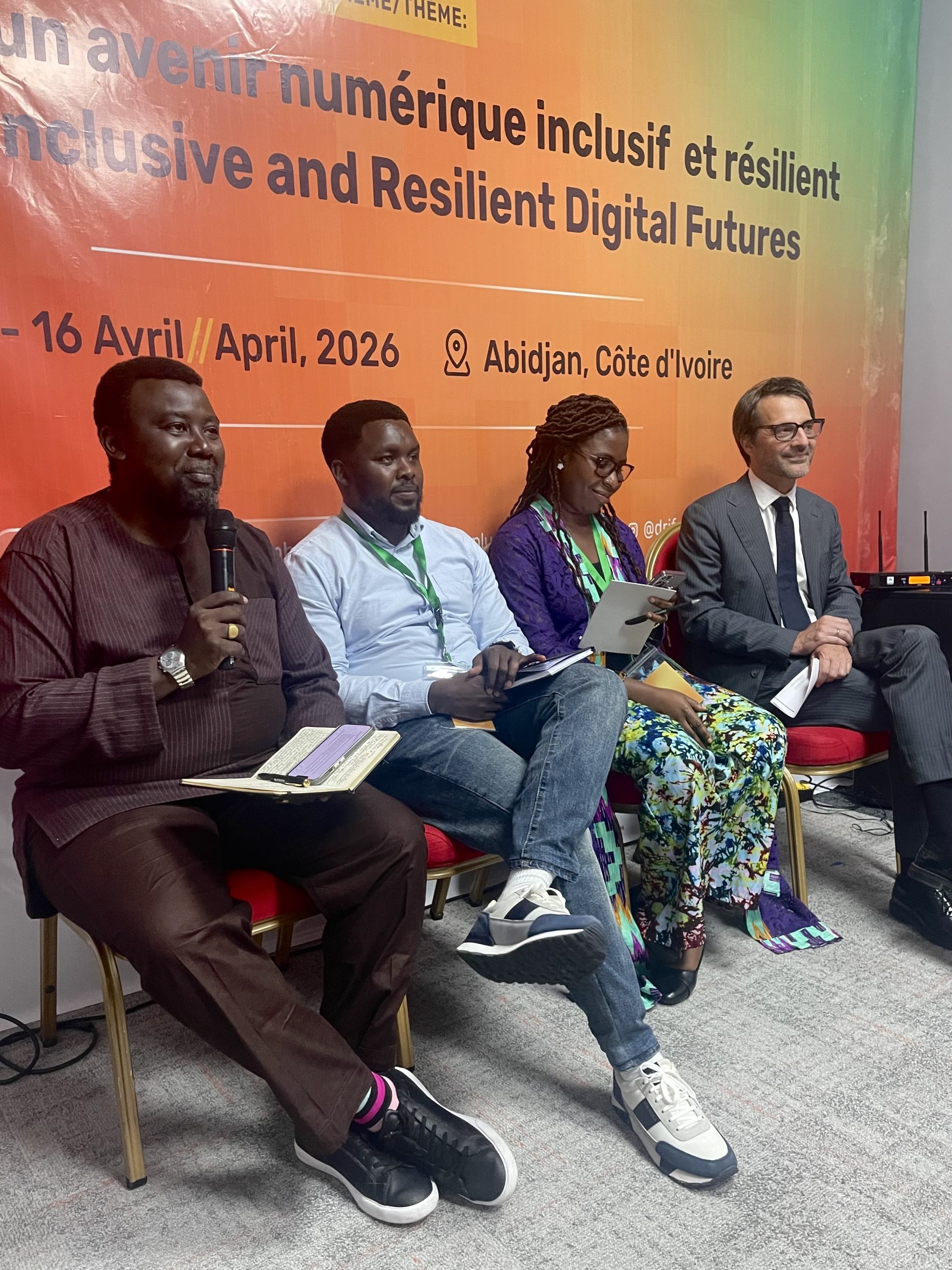
Last week at the Digital Rights and Inclusion Forum (DRIF), the FOC convened its first 15th Anniversary Regional Dialogue in Abidjan, Côte d’Ivoire – Operationalising Multistakeholder Digital Governance for Inclusive and Resilient Futures. The dialogue brought together different voices to explore key regional priorities, and to share experiences, recommendations, and challenges around operationalising multistakeholder approaches in digital governance.
Moderator
- ‘Gbenga Sesan, Executive Director, Paradigm Initiative & FOC Advisory Network Co-chair
Speakers
- Dominique Favre, Swiss Ambassador to Côte d’Ivoire, Burkina Faso, Guinea, Liberia, and Sierra Leone, 2026 FOC Chair
- Faustina Angmor, Communications Lead, International Cooperation, Government of Ghana & FOC Steering Committee Member
- Muthuri Kathure, Senior Advisor, Information Integrity, BBC Media Action
Dialogue participants explored the following themes:
Regulation vs Innovation
The pace of digital change makes multistakeholder approaches essential. You cannot regulate what you don’t understand, and that means bringing the private sector to the table alongside governments and civil society. But in Africa, the sequencing has been deeply uneven: regulation largely arrived after global tech giants had already taken hold, leaving African startups navigating frameworks that were never designed with them in mind. The challenge now is not just keeping up with innovation, but building governance processes that don’t systematically disadvantage local players before they get started.
Talking is not enough, structure matters
Multistakeholder participation works best when it is formalised and embedded in law and practice, not left as an ad hoc add-on. Ghana’s joint cybersecurity committee is a model worth examining, even if sustaining momentum and getting the right people in the room remains a challenge. Kenya’s experience shows what happens in the absence of structured participation: civil society ends up taking the government to court in order to push for a constructive dialogue at the table.
Power will not balance itself
Tensions around who gets to participate and on whose terms ran through the whole discussion. Tech companies are often absent. Citizens are rarely centred. Within civil society, large NGOs crowd out grassroots organisations working closest to affected communities. Meaningful multistakeholderism requires actively addressing these imbalances, not just opening the door and hoping the right people walk through.
From reactive to proactive
A recurring theme was the shift needed from waiting to be invited towards building coalitions, showing up early, and shaping processes from the inside. DRIF was cited as a model of proactive civil society approach. Stronger collaboration within civil society, including support and capacity-building for smaller organisations, was seen as key to making this shift real.